Showing posts with label news. Show all posts

Friday, October 16, 2015

News: Salt Lake City has launched the first protected intersection in the US

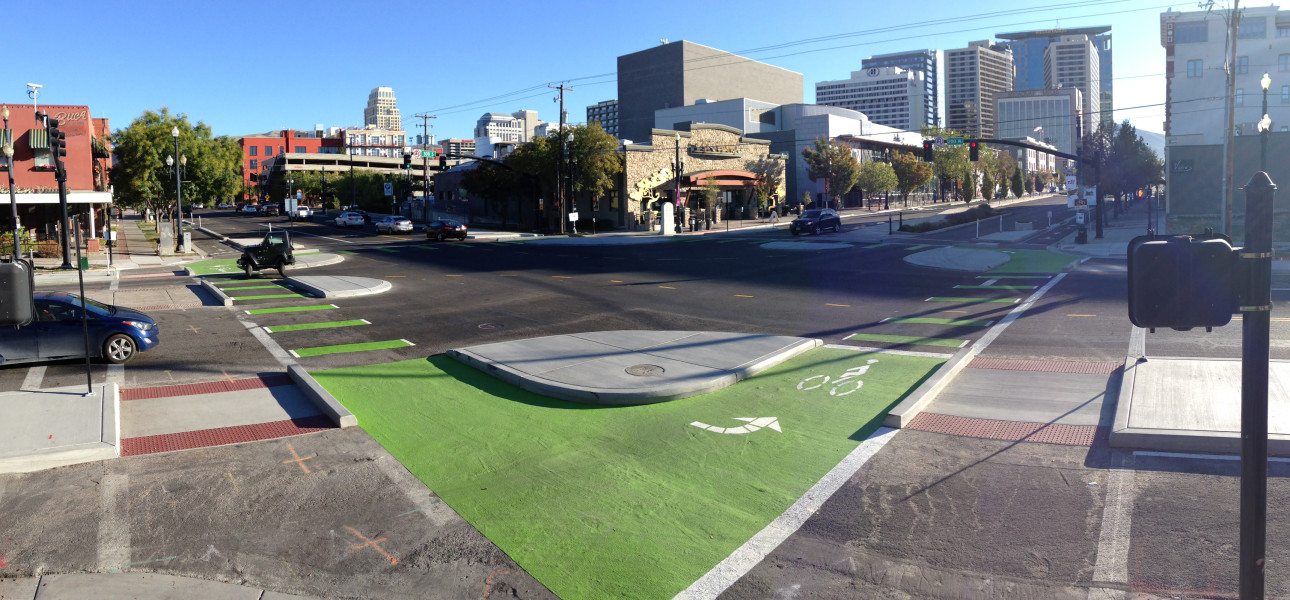
The development of cycling infrastructure is a constant struggle to balance the needs of cyclists, pedestrians, and motorists. Many municipalities continue to turn to third party design firms for new ideas on how to strike the appropriate balance, and one such firm has adapted a concept that is increasingly popular in Europe and put in place a working example in downtown Salt Lake City. Alta Design + Planning, which specializes in active transit planning drew inspiration from similar intersections in the Netherlands and worked with SLC city planners to get it implemented at a heavily trafficked intersection of two cycle tracks.

Image courtesy of Alta Planning + Design
By adding some small concrete islands in strategic locations, the new protected intersection provides clearly demarcated paths for cars, bikes, and pedestrians, extending the separation and protection offered by the cycle tracks. Additionally, by using the concrete traffic islands, a space is created to shelter bikes that need to make a left turn, making it so that cyclists no longer need to maneuver across several car lanes in order to get over to the left turn lane. This makes the entire process of a left turn much less disruptive to the overall flow of traffic and helps to reduce the potential of crashes resulting from right of way violations. As an avid cyclist, I would welcome this kind of intersection anywhere there are protected cycle tracks. The good news is that several other cities are evaluating similar intersections or in various stages of implementation.


Wednesday, September 9, 2015

News: $30 device allows thieves to steal your car

As cars have become more sophisticated, largely becoming rolling computers that are increasingly able to take over many of the tasks of the daily commute, so too have the thieves who steal them. In the old days, car thieves relied on mechanical tools like slim jims, screwdrivers, and pliers or sometimes just brute strength to break into and hot wire a car to steal it, but nowadays, with most cars using push button starting or some form of rolling code immobilizer, some much more sophisticated equipment is required, or so we thought.

Clever hacker Sammy Kamkar has created a device, costing about $30, that is not only capable of allowing someone to steal your car, but also allows them to open your garage door so that they can get at your car in the first place. Known as RollJam, the device jams and intercepts radio signals to allow an unscrupulous car thief the ability to acquire a valid code from your vehicle or garage door remote. The way it works is actually quite clever.


Wednesday, July 8, 2015

News: CA revises rules for EV incentives

We hope everyone had a safe and fun 4th of July.

In the funding plan for the upcoming 2015-2016 fiscal year, the California Air Resources Board has put in place new rules that are going to make EVs bit less expensive for a lot of people, but a bit more expensive for a select few. The new rules create a tiered structure for qualifying for the state rebate program on alternative fuel vehicles. Before, what had been an across the board rebate for all income brackets now has bands delineated by a combination of federal income poverty limit and and absolute gross annual incomes.


This new rebate structure is intended to make EVs of all kinds more affordable to lower income buyers while also ensuring that more funding is available for future investments. While some may see this change as unfair, odds are that someone with the finances to purchase a $100,000+ loaded Tesla Model S is hardly going to notice the difference that the $2,500 additional rebate was going to make and those individuals are still eligible for the even larger federal rebate. Plus, the increased incentives for lower income families should hopefully make the idea of an EV more appealing for those that commute to a job that is not too far away and can charge the vehicle at home.

As EVs continue to become an increasingly viable form of alternative fuel vehicle, it is good to see the state of California recognize that the incentives have largely benefited those who need it the least and is taking measures to help increase access to EVs for those in lower income brackets.

Wednesday, May 27, 2015

News: The League of American Bicyclists Bicycle Friendly States Rankings

Image courtesy of the League
of American Bicyclists

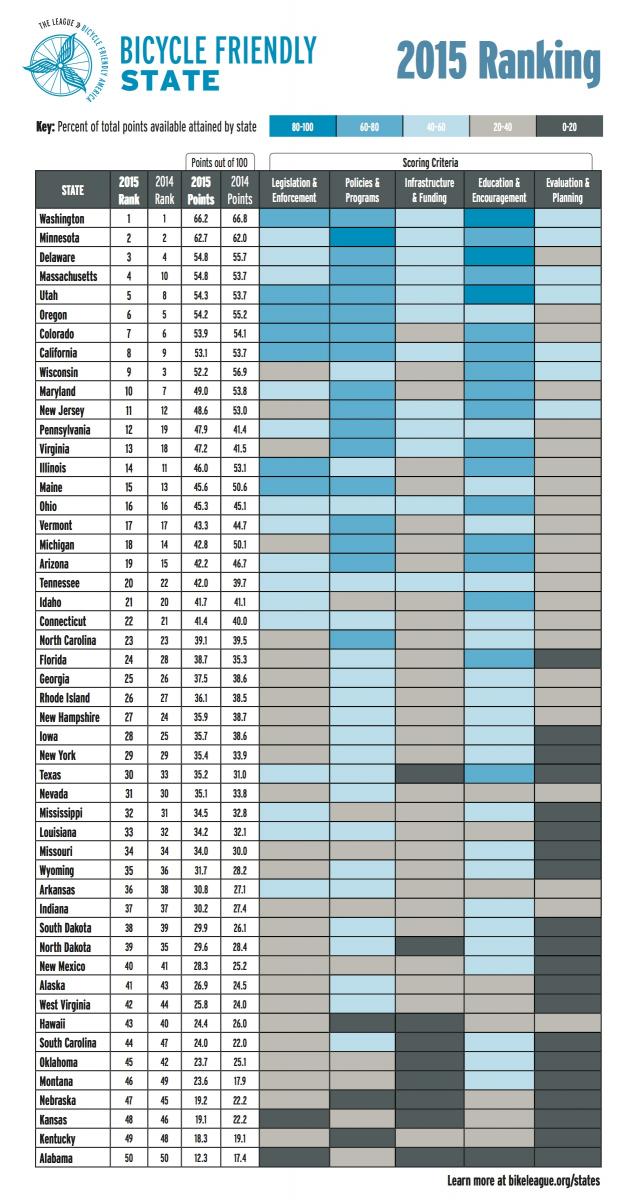
As May and Bike Month draws to a close, the League of American Bicyclists has released its latest ranking of all 50 states by how bike friendly they are. The ranking takes into consideration multiple areas that contribute to bike friendliness, including everything from legislation to infrastructure to education. It should be no surprise that the states containing highly bike friendly cities such as Portland, Minneapolis, and my own Long Beach would easily rank into the top 10 states. Most of these states, such as Washington, Minnesota, Massachusetts, and Oregon, exhibit excellent policies, education, and enforcement of legislation, while even the best states still only get middling marks for infrastructure. Those states at the bottom are, unsurprisingly, those that are least densely populated and thus least likely to attract cyclists and their ever-present drumbeat for greater infrastructure and education.

There are a few surprising results, such as how high Delaware scores, even though it is not often recognized as being particularly bike friendly, or how poorly New York State did, even though New York City is considered among the most bike friendly cities in the US. Of course, having biked now in numerous cities across the cities, albeit for rather short periods of time in some cities, it is encouraging to see not only how much infrastructure is being built, but also how cycling is continuing to be adopted by those in urban environments as more than just recreation, but as a means of transit on a regular basis.

Check out how your state did by going to the League of American Bicyclists website and make sure to view the details of your own particular state. Then, take a moment to consider signing up for your local bicycling advocacy organization to help support making cycling safer and more more accessible to everyone!

Friday, February 27, 2015

News: Legislation Proposed for a Federal Ban on Traffic Enforcement Cameras

Image courtesy of USAToday
I am not yet sure what to make of this, but earlier this month, Ed Perlmutter a legislator from the state of Colorado, proposed legislation to put in place a federal ban on the use of traffic enforcement cameras, including both red light and speed cameras. The motivation comes from the belief that the cameras are not used in the interest of public safety, but rather to fill the coffers of local municipalities to the detriment of the pocketbooks of local drivers. In the city of Denver, traffic enforcement cameras have netted more than $34 million in revenue. Having had my share of experience with these cameras while living in DC, I can certainly attest to the fact that I am no fan, but a full-on federal ban might be a bridge too far.

Wednesday, February 11, 2015

News: Volvo and Jaguar-Land Rover introduce car safety tech to protect cyclists

It warms my heart when I see automakers doing things to make cycling safer. As cars and bikes continue to increasingly share space on public roads, the addition of new technologies to allow the two modes of transport to coexist. Many of these technologies simply focus around awareness, making drivers more aware of the presence of bikes in their immediate vicinity or cyclists more aware of upcoming cars. Primarily, Volvo and Jaguar-Land Rover have created new tech that they hope to incorporate into future cars to help drivers and cyclists to be safer together.

Volvo's approach is a two-way communication system that requires both technology in their cars as well as technology in cyclist's helmets. By allowing the helmets to communicate with the cars, it is possible to make drivers aware of the presence of a cyclist, helping to reduce accidents that result from drivers failing to notice a cyclist in their blind spot. Additionally, since the communication happens in both directions, the helmet will also warn the cyclist of the presence of a nearby car. The technology relies on Volvo's cloud network that links their vehicles in order to feed the data to the cars or apps which the smart helmets would be linked to, so it is likely that some kind of subscription may be required. And while this technology sounds like it has great potential, the relatively small number of new Volvo cars on the road today in the US means that we will likely see limited effectiveness of this technology unless other manufacturers also begin to adopt it.


Jaguar and Land Rover, however, are taking a totally different approach. Instead of relying on a two-way communication system, JLR's setup, known as Bike Sense, uses the various sensors already in the car for various existing safety tech and adds a layer of notifications on top specific to cyclists. For instance, if a cyclist is nearby, the car will notify the driver by playing the sound of a bike bell through the audio system. If a cyclist is detected in the blind spot, the car will use the air bladder in the shoulder bolsters to tap the driver on the side that the bike is approaching from. In addition to audio and physical cues, visual cues are incorporated as well using a series of LED lights hidden in the pillars and upper door panels that change color as a a cyclist approaches. And in a stroke of absolute genius, JLR has also incorporated door handles that vibrate if a cyclist is approaching, helping to reduce incidences of dooring. Best of all, the tech is calibrated to work with not only bicycles, but can apply to motorbikes as well.

While this kind of technology is still fairly rare, it is great to see that the automakers are recognizing the importance of their 2-wheeled compatriots on the larger transportation landscape. This kind of technology investment, especially as cars become increasingly aluminum intensive, and thus more costly to repair, should help cyclists be better protected, but should also help car owners to protect their investment as well. Plus, the added bonus of making our roads safer for everyone is a reality that cannot be ignored. As an avid cyclist, I am excited to see how this kind of technology continues to develop and hope that the increased awareness by drivers can lead to even bigger systemic changes in the future.

Click past the jump to read more about these exciting new safety technologies.

Friday, December 12, 2014

News: Improving road safety through technology

Image courtesy of Extremetech.com
In the past year, we have seen announcements of research into a large number of different new technologies intended to make our roadways safer for all users. Everything from car-to-car communications, which would allow vehicles on the road to be able to talk to each other to help avoid accidents, to pedestrian safety technology, with improved capability to recognize pedestrian and cyclists to avoid crashes, to self driving cars. All of this technology is intended to help drivers avoid crashes with each other as well as other road users.


Wednesday, November 5, 2014

News: Tom Magliozzi, long-time host of NPR's CarTalk, passed away this week

Image courtesy of WBUR.
This week, the automotive and radio worlds lost a great voice. Tom Magliozzi, half of the pair that makes up the Tappet Brothers of NPR's CarTalk radio program, passed away from complications from Alzheimer's disease. As a long-time fan of the show, my weekend morning routine often consisted of making my breakfast while listening to Tom and his brother Ray cackle and tease each other through some hilarious calls, helping listeners along the way to solve many automotive conundrums, or at the very least, get a good laugh out of the crazy questions. Tom's passing is truly a loss to public radio listeners and the automotive world, but also the cycling world. In fact, Tom has always been a major supporter of cycling, stating in a 2002 interview that he does not even own a car and prefers his bicycle and public transportation to get around the Boston suburb that he calls home.

Our condolences go out to the Magliozzi family, in particular to Tom's brother, and co-host on CarTalk, Ray. Hopefully Tom's legacy can continue to live on in the form of the ongoing presence of re-edited versions of CarTalk on NPR's weekend radio line-up.

Tom Magliozzi, thank you for the many hours of laughter and education you brought to your listeners. You will be missed!


Friday, October 10, 2014

News: Tesla announces AWD Model S and Autopilot features

Every Tesla fan was likely glued to the web last night to find out about the latest from the electric auto maker and Elon Musk did not disappoint. The announcement of a dual motor all-wheel-drive version of the Model S corroborates the various rumors that had been swirling around all week. However, unlike the usual AWD systems, which saddle cars with extra weight and complexity, contributing to losses in performance and efficiency, the dual motor AWD system in the Model S seems to do exactly the opposite, actually improving efficiency and increasing the cars overall range while adding nearly 50% more horsepower and dropping the 0-60 mph time by over a full second in the now 691-hp P85D trim. Judging from the various videos floating around online of first impressions, this thing is an absolute monster.

On top of all this Tesla has also announced that starting from two weeks ago, every Model S built has the hardware installed for its new Autopilot features, which will be a part of the Technology Package going forward. This adds several cameras, sensors, and systems to allow the Model S to virtually drive itself. The car is able to operate the throttle, brakes, and steering to essentially drive itself, doing everything from managing your cruising speed by reading the speed limit signs to executing a lane change upon command, all without the driver touching the steering wheel or pedals. While the hardware has been included in recent production cars, the software to power this impressive feat of automotive engineering is still being finalized and will be released as a part of an over the air update. Unfortunately, there is no way to retrofit the hardware to older Model S cars.

As huge fans of the Model S, it is hard not to applaud Tesla for adding such admirable improvements to their cars, especially in an ongoing manner. The addition of such features not only toes the line on what is legally allowed at the moment for autonomous vehicles, but also shows that as a company, Tesla is committed to continued innovation. We look forward to taking a test drive of a car equipped with these new features so that we can share further impressions.

More details linked after the jump.


Wednesday, October 8, 2014

News: Bike lanes do not slow down car traffic

Many drivers have the misconception that anything that removes space from their precious roads is an impediment to their forward progress. The loss of lanes to parking is already an affront to their vision of free-slowing traffic, so one can only imagine that the loss of a traffic lane, or even the reduction in the size of a traffic lane, in order to install a bike lane would be a truly serious offense in their eyes. The idea that slow moving traffic would somehow have no impact on the free flow of traffic seems antithetical to traditional logic.

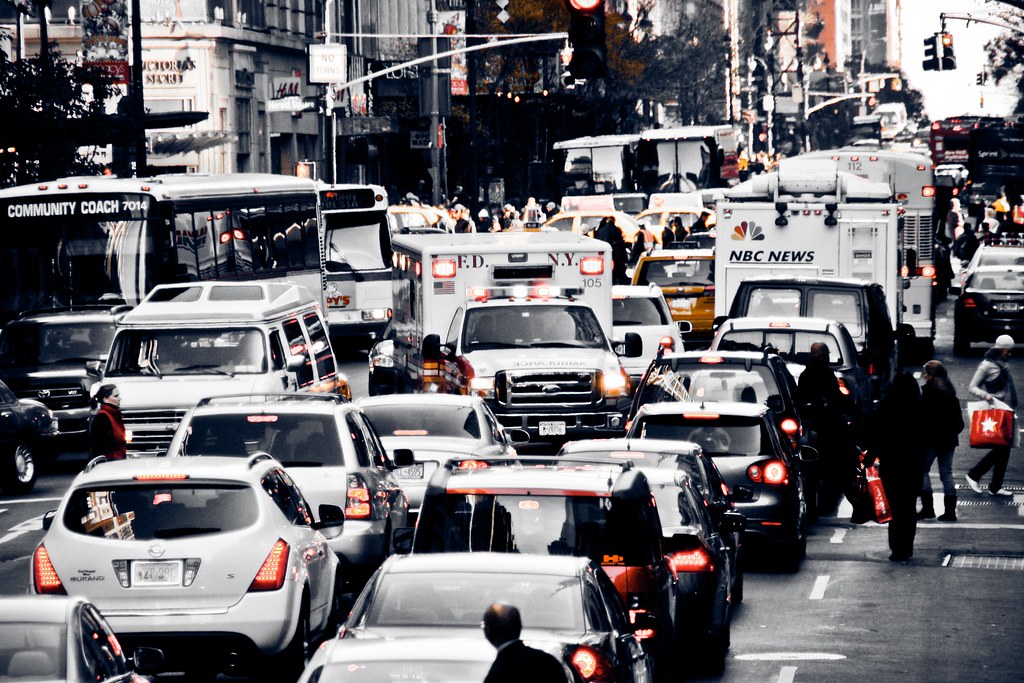
And yet, a recent study of bike lanes in New York City, one of the most traffic snarled metropolises in the US shows precisely that. The installation of bike lanes, particularly those protected bike lanes that completely separate car traffic from bike traffic, have not only not slowed down traffic, but in some cases, have actually improved traffic flow. On top of that, not only has traffic improved, but cyclist injuries, pedestrian injuries, and traffic incidents have decreased in significant numbers.

If in a massively traffic snarled city such as NYC, protected bike lanes are able to have such a tremendous impact, imagine what adding these to other major cities, such as Los Angeles, could do to improve driving conditions and reduce congestion. NYC has the obvious advantage of greater population density, but even adding them to the immediate suburbs surrounding the city of Los Angeles would make a tremendous difference in the near term and combined with greater investment in public transit options, could make dramatic improvements in the long term. Hopefully more studies will continue to reveal that increasing bike traffic in major cities is a great way to ease car congestion and, perhaps, reduce pollution as time goes on.

Link to the full study after the jump.


Monday, February 24, 2014

News: Suffolk County, NY legislator wants no bicyclists or motorcyclists on his roads

Here is a new twist in the 2-wheel vs 4-wheel debate.

Matthew Cutrone, a young concerned citizen wrote to his legislator about the recent accident that involved his mother, who was riding a bicycle, being hit by a work van whose driver claims he did not see her (an all too common excuse, unfortunately). In the letter, young Matthew asks for the addition of a bike lane or signs in the area to raise driver awareness of the presence of bicyclists. The request seems like a perfectly legitimate one and would hardly have been difficult to implement plus would have likely had widespread support given that Suffolk County, which comprises the majority of Long Island, is popular with cyclists for its many miles of coastal roads.

The response from one Thomas Barraga, however, could not have been any more absurd. Instead of replying in a diplomatic manner, he chooses to talk about how he actively tells people not to take up bicycling and that "drivers expect to see other drivers on the road not bicyclists and motorcyclists." He goes on to talk about how signs and bike lanes are worthless because they do not have much effect since drivers ignore them. It seems that Mr. Barraga has it in his head that nobody but drivers have rights in Suffolk County and that, just because he personally seems to dislike them, everyone else should stay off his roads. Perhaps while we are at it, we should remove crosswalks and sidewalks too since drivers would not expect to pedestrians either.

I have never heard such an utterly outrageous response and, as a bicyclist and motorcyclist, will be all too happy to stay away from Suffolk County and never bring my hard earned dollars to that part of New York. However, if this is how local legislators think about the 2-wheel vs 4-wheel issue, then it is no wonder we cannot make any progress and have civil discussions about real solutions. I hope that most people are smarter than West Islip's village idiot and can see the absurdity of his narrow world view.

Here is his letter, word for word:

Friday, February 14, 2014

Valentine's Day: Women Most Attracted to Men in Pickup Trucks?

A recent survey by Insure.com wanted to know what kind of cars attracted men and women to the opposite sex. From what we see everyday in the media, I had thought that this topic pretty much already had its answer. Needless to say, the results were somewhat surprising.

Women on an Attractive Man's Car
Image courtesy of Truck Trend
Our media generally portrays women as being attracted to men with sports cars or exotic cars. Based on this survey, at least, it would seem that a large majority of women like a man with a pickup truck. Admittedly, this result surprised me a bit. When I think of a man in a pick up truck, I generally think of three types of men: 1. the frat boy or surfer with their lifted "bro" truck, 2. rednecks or 3. the construction worker or farm hand that actually needs the truck for work. I can maybe see why a woman could be attracted to a hard- working man who uses his truck for its intended purpose, but not so much the "bro" truck owner.

This survey also asked of women what make and color their attractive man would drive. The results put Ford as the top runner for make, with the color black being the women's car color choice for the attractive man. Why? Ford's best selling vehicle is the F-150 pickup truck after all. As for the choice of color? We will get to that in a little bit.

Wednesday, January 8, 2014

News: Contractor for Uber involved in deadly accident

Image courtesy of Autoblog.com
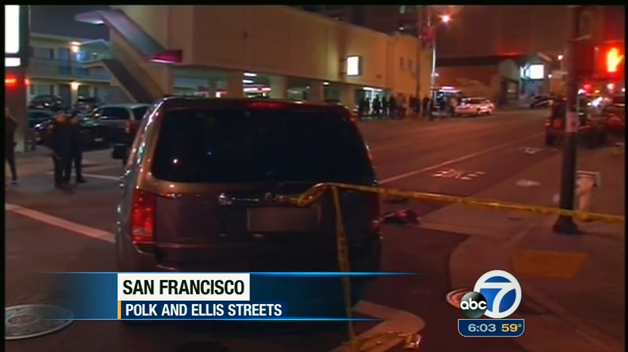
Just before the new year, an accident in San Francisco left a 6 year-old girl dead and her mother critically wounded. The driver, Syed Muzzaraf, was behind the wheel of his Honda Pilot and turned into the family, who were utilizing the crosswalk at an intersection, without yielding to their right of way. Additional details are not clear at this time, but initial reports did not indicate the involvement of alcohol or any other controlled substance and the driver appeared to be entirely in control of the vehicle at the time.

While this would normally be buried in the local section of the newspaper and little more than a blip on the evening news, the fact that the driver was a contractor for the ride sharing service Uber has somehow raised it to the status of national news. Rather than focus on the dozens of other potential issues that this incident could help highlight, such as better pedestrian crosswalks or EMT response time or improved licensing requirements, the news media has instead decided to focus on whose insurance should foot the bill. They are trying to make the case to have Uber's commercial insurance cover the incident, even though Muzzaraf was not actively transporting an Uber customer at the time.

Rather than focusing on the causes for the incident, such as lack of driver patience or inadequate driver training, the attention has been shifted to avoid examining some of the deeper issues that create dangerous situations on our roadways. The death of young Sophia Liu will be trivialized in an effort to create a bigger story and the responsibility of the driver, Muzzaraf, will be minimized, allowing him to slip out of the limelight. If instead we focused on the underlying causes for the problems and made solutions to treat them instead of always only addressing the symptoms that bubble to the surface, we could help prevent these types of incidents in the first place.

We hope that Sophia's mother will recover from her injuries and our deepest sympathies go out to the Liu family for their loss.


Tuesday, December 10, 2013

News: Nissan Leaf Owner Arrested for Charging Car Without Asking

Image courtesy of Accuracy in Media
With more and more electric cars hitting the roads, public charging stations are popping up almost as fast as the cars are being sold. However, with only about 6,800 public charging stations available in the United States, charging your electric car away from home is not always an easy proposition.

Such was the case for Nissan Leaf owner Kaveh Kamooneh. Kamooneh plugged his Nissan Leaf to an external outlet at a Chamblee, GA middle school where his son was taking part in a sporting event. After charging his car for only five minutes, a police officer approached and asked whether Kamooneh had permission from the school to be using the outlet. Kamooneh noted that there were no school staff around at the time, and the officer accused him of stealing. Kamooneh was arrested at his home 11 days later, and was forced to spend a night in county jail. How much electricity did Kamooneh actually steal? Reports claim a paltry five cents. According to a Chamblee police sergeant though, the amount did not matter. The sergeant claims that the fact Kamooneh was stealing was what mattered.

Because there is not an abundance of electric car charging stations across the nation, there may come a time in an electric car owner's life where they will need to charge their car at a stranger's home, a store, or, in Kamooneh's case, a school. Until the infrastructure for public charging stations can be beefed up, it would seem there needs to be some sort of social protocol regarding charging an electric vehicle outside of a public charging station.

So I ask you, dear readers: what do you think the social protocol for charging an electric vehicle with someone's electricity should be? Should we really treat this any differently than someone plugging their iPhone into a public outlet for a quick boost? Do you think an electric car owner should be able to just walk up to an outlet in a public area and plug their car in without permission? Is that really an offense that someone deserves spending a night in jail for, especially for such a minuscule amount?  Let us know what you think in the comments below.

Read the original news article here: Nissan Leaf owner arrested for taking 5 cents of energy without asking

Sunday, October 13, 2013

Editorial: Holding innovation to higher standards

A little more than a week ago, a car fire occurred outside Seattle, WA. Seems like rather insignificant news, right? Car fires are a daily occurrence around the country and most people drive by them without so much as a second look, although most likely accompanied by some colorful language at the traffic congestion that is caused by the rubber-necking that occurs anytime flashing lights are seen. However, the fact that this car fire was the first involving a Tesla Model S someone warranted national news coverage. The Model S in question was damaged by a large piece of debris that fell off a semi-truck. The debris in question hit at such an angle and with such force that it punctured the extra thick metal casing that houses the battery, resulting in the cooling system for one battery compartment to fail, which ultimately caused the fire.

With all the coverage, one would expect there to have been a fatality, or at the least severe injury, involved. Someone must have gotten hurt or something dramatic must have happened, right? Otherwise, why would we be holding this innovative new technology to a higher standard than the technology we currently have?


Thursday, August 8, 2013

News: Melbourne's Motorcycle Paramedics

Photo courtesy of gizmag.com
As a motorcyclist, I have always wondered if there are ways in which the motorcycle might make a greater contribution to society in ways that have not been thought of yet. Recently, I read about a TED Talk given by a man in Israel had started a company to provide ambulance service using motor scooters. The benefit provided was the ability to carry everything that an ambulance has, except for the gurney, albeit in more limited quantities, and to ease through traffic much more easily than a full-sized ambulance. The concept itself is not a new one as several countries have been testing these motorcycle ambulances or have been using motorbikes as medical transplant organ transports for years now.

One such city is Melbourne, Australia. They have launched a new trial using several fully kitted out BMW GS motorbikes that carry full scale medical kits in panniers and cases on the bike. In addition to the kits, the bikes have been outfitted with the flashing lights, sirens, and radios needed to do the job. The rider of tone of these bikes was kind enough to allow a photographer to follow him during the course of a day and record various moments. What resulted is the photo-diary linked below.

The rider points out several key advantages as well as disadvantages of using motorbikes in this capacity. Key among the advantages is the ability to utilize the bikes smaller size to squeeze between cars and filtering through traffic. Additionally, the bikes are narrow enough that they are able to use some trails and sidewalks that no full-size ambulance could ever take advantage of, saving time and allowing the paramedic to arrive quicker to the scene of an incident. However, there are definitely a few drawbacks. The nature of the motorbike makes it far more vulnerable than the traditional truck based ambulance and that they are more prone to being ignored due their smaller size. Of course, the advantages seem to outweigh the disadvantages and the program seems to be something that is likely to live on in Melbourne and in many other places around the world.

But would something like this work in the US? Is this an idea that could be implemented in some of the large American cities where traffic often does cause delays for first responders? Are American drivers disciplined enough to allow a motorcycle riding paramedic to pass or is this potentially a recipe for disaster? Share your thoughts with us in the comments below! Links to the photos and and TED talk after the break.

Tuesday, July 16, 2013

News: Hertz expands rental of performance and exotic cars

An original Mustang GT350H, part of the Hertz
Rent-a-Racer program of the 1960's.
Once upon a time, the American enthusiast was able to go to his or her local Hertz rental counter and indulge themselves with the rental of a Carroll Shelby tuned Mustang GT350H. Some customers were purported to have taken the cars and actually gone to the race track or drag strip. Others claimed to have taken the motor out of the Hertz Shelby to install in their personal race car for the day, returning the mill to the rental car before dropping it back off at their rental car location. People came up with all sorts of creative ways to enjoy the cars and it was genuinely a golden age for enthusiasts. By offering this on-of-a-kind Rent-a-Racer program, Hertz generated a great deal of loyalty among enthusiasts. However, while the program was a success for customer loyalty, the cost to maintain the high performance fleet became excessive and eventually, Hertz did away with the program entirely.

Fast forward to 2013 where Hertz is back with a selection of high performance and exotic cars available for rent through the Hertz website. The list of models is quite extensive with options ranging from the Ford Mustang GT and Chevy Camaro to exotics like the Audi R8, Mercedes SLS AMG, and even a Tesla Model S. The cost varies greatly depending on the model of car, but something like a Porsche Boxster can be had for a not totally unreasonable $395/day. The only real restriction is that only 75 miles are included with the rental with additional mileage available at a fixed rate per mile. Other normal rental car rules and policies apply, but it is an opportunity to get behind the wheel of an otherwise less attainable vehicle for the average enthusiast.

Read more about the program after the break.

Thursday, July 11, 2013

News: Electric Motorcycle takes class win at 2013 Pikes Peak Hill Climb

With the 2013 Pikes Peak International Hill Climb, there is a shift in the paradigm of this storied race. With its 156 turns and nearly 10,000 feet of elevation change, Pikes Peak is a grueling test for any vehicle and any driver. Many competitors build customized cars and motorcycles specifically designed to tackle this course and its unique challenges. At this year's race, we saw a new first: the first time that an electric vehicle has won a class not specifically designated as being for electric vehicles only. Yes, that's right, the electric vehicle has bested its gas-powered counterparts. Lightning Motorcycles, a manufacturer of electric motorcycles, outright won its class this year with its entry, besting entries from racing stalwarts such as Ducati.

This is particularly exciting because it signals that, at least with motorcycle racing, electric bikes absolutely have the ability to compete with their fossil-fuel powered counterparts. It could also signal the possibility that electric motorcycles will gain further popularity for street use as the technology begins to reach a point where the cost and performance are becoming comparable. Call me a fanboy, but I see this as further proof that electric vehicles have a viable future as a part of our transportation infrastructure.

Link to the original article after the jump.

Tuesday, June 25, 2013

News: More than 50% of NY Drivers Fail the Basic Road Test

Image courtesy of RealSmiley via Flickr
When I read this headline, I was genuinely scared for my life. I understand that budget cuts have taken driver's education out of most high school's curriculum, but that should mean that the slack is getting picked up somewhere else. Of course, not all families can afford to pay for professional instruction, but if their performance on the road is any indication, most parents are not fit to teach their children to drive either. This puts us in quite the quandary as it means there will be an ever increasing number of drivers on the road who eventually managed to squeak by to get their license and the current road test is not even that difficult in most states. As if the state of traffic in places like NYC were not bad enough already.

For me, this is an indicator of things to come for our driving culture. In fact, I just had the wonderful misfortune of being involved in two traffic incidents in as many weeks. In both instances, my vehicle was at a complete standstill at an intersection and in both instances, someone else crashed into me, once from the front and once from the rear. Both times, the accidents could have been entirely avoided with greater attention paid to driving and not on some form of distraction. If this news piece is just the start, I should probably expect to have more run-ins with these types of situations in the future as more and more drivers who are barely qualified are allowed out onto the roads.

Tell us in the comments what you think about this situation? Does it also scare you? Or are you excited at the not too distant prospect of playing dodge car every day on your way to work?

Friday, June 7, 2013

News: Cell phone carriers unite against texting while driving

Image courtesy of USAToday.com
Distracted driving is becoming ever increasingly problematic as cars get more complex and filled with technology and as our real lives become ever more intertwined with our digital ones. Most people now have some form of touchscreen mobile device that they use on a regular basis, mainly in the form of a smartphone that is with them at all times, including in the car. Many individual cities and counties have taken measures to combat distracted driving by instituting handsfree cellphone laws prohibiting handling of the phones while operating a vehicle. Automakers are also doing their part by offering technologies that allow users to access the most frequently used functions of their phones through voice commands and integration with the car's infotainment system. And now, the big 4 cellphone carriers, have united behind an anti-texting ad campaign to discourage people from texting behind the wheel.

Having been the victim just earlier this week of a distracted driver's inattention, I am encouraged that the cellphone service providers are taking part in this kind of campaign and taking a stand against a habit that is growing into a major problem out on America's highways, especially around urban centers where people's busy lives often force them to need to be connected as often as possible. Distracted driving is a serious matter and is often a contributor to accidents and road rage incidents, so any steps to combat it are steps in the right direction.

Tell us your thoughts on distracted driving or share with us the story of how distracted driving has impacted you in the comments section.