"There's no replacement for displacement!" This was a common phrase I heard throughout high school, as most of my car nerd friends were into good 'ol fashioned "American Muscle." That phrase was their rallying cry. "Oh, you got a tiny little 2.0 liter turbo charged four-banger? You ain't got nothing on my 352 Hemi!" or some variety of that would be their attempt to put down cars with forced induction. I didn't really care much for the phrase, but I also didn't really care all that much for forced induction at the time either. In my high school years and throughout college, I was into high revving, small displacement, naturally aspirated engines. Honda's F20C, K20A, and B18C5 were my engines of choice. The largest displacement motor that had my attention was the Honda C32 3.2 liter V-6 found in the Honda/Acura NSX.
Now that I live with a turbo engine for daily driving, I started to think about the whole "no replacement for displacement" argument again. Why? Because the 1.5 liter turbo four in my Civic Si makes nearly as much horsepower (post ECU reflash) as my S2000, and makes way more torque. Heck, after reflashing the ECU in my Civic, it almost makes as much torque as the V-6 in our departed 2016 Accord Touring. In the age of almost every vehicle coming off the factory line with a turbocharger, it almost feels like the argument for larger displacement should no longer exist.
Of course, the troll in me always felt the "no replacement for displacement" argument was a load of garbage anyway. Even when I was in high school, I would always argue back, "well, what if I stuck a turbo or supercharger on your giant engine...wouldn't that make more power?" More often than not, my muscle car friends would always bring up the Dodge Viper's enormous V-10 as the "crowning achievement" of displacement over forced induction. I would always argue back, "but they make turbocharger kits for the Viper's V-10..." or "XYZ engine with less displacement and forced induction makes more power..." For those of you not familiar with Dodge's ginormous V-10, the 2017 version of the admittedly old school 8.4 liter V-10 makes 640 horsepower and 600 lb/ft of torque. For comparison's sake, you can get a 2017 C7 Corvette Z06 with a 6.2 liter supercharged V-8 that makes 650 horsepower and 650 lb/ft of torque. Yes, more horsepower and torque from an engine that is an entire F22C size smaller, all because it has a (giant) supercharge strapped to it.
In this day and age where factory forced induction is now the norm (for emissions/fuel economy purposes though), the "no replacement for displacement" saying really means absolutely nothing anymore. If you want to really get technical, a lot of today's electric cars are faster than big displacement muscle cars, and their electric motors aren't even measured by displacement at all! I love big block engines as much as the next car nerd, but even I know that the future of performance lies in forced induction, hybrid technology, and pure electric power. There will always be a place for good 'ol fashioned Detroit Iron, but I have to question for how much longer.
Following the recent election, the future of many major industries is likely to be in flux, the automotive, motorcycling, and even cycling industries in particular. Each of those industries has their distinct structures for design and manufacturing that can make the idea of "buying American" a difficult one to define. All of them are manufacturing industries that rely on "overseas" manufacturing jobs to one extent or another and with promises from the incoming administration to correct trade imbalances and place tariffs on products made overseas for sale here in the US, there is a lot of uncertainty about what potential impacts there are. And in this day and age of globalized economies, figuring out what exactly is "made in America" is not necessarily clear cut. So when it comes time to purchase that new motorcycle, bicycle, or car, what exactly does it mean to buy American?
When I was a freshman in college over a decade ago, Metrolink and I became well acquainted. It was an easy way to get from the small town where my school was, which fortunately had a stop, and the Inland Empire or Downtown LA. The trains were reasonably comfortable, seeing as they were intended for commuters making the daily slog to their jobs in the city, and the ridership during the weekend tended to be largely students going home or the occasional tourist who opted not to rent a car. The trip duration could tend to be on the long side and since rail infrastructure in Southern California is not exactly well developed, once I reached the end of the line, it could take a fair amount of planning to actually reach my final destination. Being a poor college student at the time, that often meant the "last mile" portion of my trip was either another form of public transit or an awful lot of walking. However, after I got a car my sophomore year, I pretty much have never set foot on Metrolink again...until yesterday.
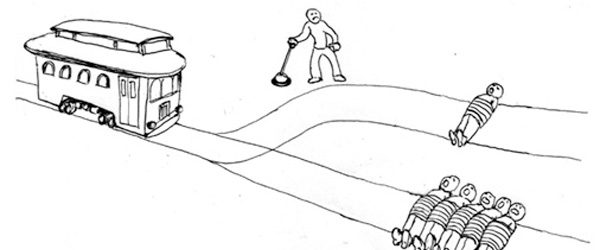
For those of you who are unfamiliar with what the "Trolley Problem" is, it's actually quite simple. It's a simple thought experiment in ethics that asks you to imagine a trolley headed towards a track with five people tied to it. By pulling a lever, you can divert the trolley to a different track with one person tied to it. So the question here is whether or not you do nothing and let five people die, or do something and let one person die. But what does any of this have to do with cars? With the advent of autonomous cars hitting our roads within the next few years, people have begun to ask a similar question, but about autonomous cars: should the car be programmed to avoid hitting pedestrians, but possibly endangering the occupants, or to hit the pedestrians and save the occupants inside the car?
It's an interesting question that doesn't seem to have a truly correct answer to...unless you're Mercedes-Benz apparently. During the most recent Paris Motor Show, Car and Driver spoke with Mercedes-Benz's Manager of Driver Assistance Systems, Cristoph von Hugo. During their interview, Car and Driver brought up the "Trolley Problem" with von Hugo, knowing full well that this is a question that manufacturers do not like to address. Oddly, von Hugo did address the question, stating that Mercedes-Benz's level four and five autonomous vehicles would prioritize saving the occupants of the vehicle.
While not implicitly stated, von Hugo's answer does imply that Mercedes-Benz's autonomous vehicles will run over a group of pedestrians if it means saving the occupants inside the car, or as Jalopnik's Raphael Orlove so eloquently puts it: "My dude. Holy shit. You know what you’re saying there, right? You’re
saying that a Mercedes S-Class or whatever, driving down the road, will
happily if not gleefully run over a child if it guaranteed saving the
caviar-guzzling millionaire inside. Not just a child. An orphan. A group
of orphans. A group of sick, orphans with leprosy."
Again, this goes back to the idea that there really is no correct answer to the "Trolley Problem." For a car manufacturer, any answer given will shovel bad PR its way. Save the pedestrians? Why is your company's car killing its customers to save random people? Save the occupants? How could you let your autonomous vehicle become a rolling death machine? In the end, someone is going to be upset and someone is going to get sued.
So, readers, I pose the question to you: if you were in charge of programming the brain of a new autonomous vehicle, how would you try and solve "Trolley Problem?"
Update:
So it would seem that as I was writing this article, Mercedes-Benz has clarified that some of von Hugo's comments in the Car and Driver interview were left out. Mercedes' official stance on the problem is "...neither programmers nor automated systems are entitled to weigh the value of human lives." In short, Mercedes-Benz is now also side-stepping the question along with other auto manufacturers.
The debate has been a long and boisterous one, but after all the battling, the stats finally won out and the state of California is the first in the US to officially make lane-splitting legal. Lane-splitting has always drawn a lot of controversy in America, a country dominated by car drivers who selfishly believe that the roads are theirs and theirs alone.
Even in California, the practice had previously only been allowed because it was not expressly disallowed. The California Highway Patrol (CHP) supported it because it allowed their motor officers to move more freely through the gridlock traffic that burdens the greater LA and San Francisco areas during nearly all hours of the day. Motorcyclists support it because it allows riders the ability to move through traffic and keep air flowing to prevent overheating (mostly of the rider, though some older bikes benefit from it too). Car drivers, however, have long disliked the practice because it requires that they be more attentive about lane position and lane changes. Still, most drivers who have lived in California long enough have grudgingly adapted to it, some better than others.
But by taking it from a tolerated act by virtue of lack of legislation to a totally legal act backed by legislation and with guidelines to be provided by law enforcement, California has changed the game. By making it expressly legal, California is saying that lane-splitting is not just safe enough to be a practice, it is safe enough to be a law. That has long been a major argument used by detractors of lane-splitting to fight its implementation in other states. Many opponents have argued that by allowing one kind of traffic to travel between other traffic, it increases the chances for collisions, even though this has not been backed by the statistics. If anything, it has reduced one of the most common car-motorcycle collisions, which is motorcyclists being hit from behind in slow moving or stopped traffic. When practiced with abundant and appropriate caution, lane-splitting makes motorcyclists safer with little impact on car drivers at all.
By taking the step to make lane-splitting a fully legal act, California is hopefully the first domino to fall in what will eventually be more states allowing the act. Attempts have been made to legalize lane-splitting in states such as Arizona and Oregon, but all were quashed by legislators representing car-centric constituents who are fearful of change. But now that someone else has taken a major leap, hopefully more attempts will be made to bring up lane-splitting legislation and more "trial periods" will be considered as other state legislatures begin to realize the potential safety and traffic relief benefits that lane-splitting can bring.
Tesla has been in the news a lot lately, and not because the Model X is a runaway success, or the Model 3 is going to be the next best thing since sliced bread. Tesla has actually been in the news a lot lately due to the semi-autonomous driving capabilities of their cars. Dubbed "Autopilot" by Tesla, this mode will take over control of your vehicle much in the same way other manufacturers' Active Cruise Control and Lane Keep Assist works. By using a series of sensors at the front of the car, the Model S and Model X can now maintain cruising speed, distance, and lane without any driver input.
And therein lies the problem. Even though the system was designed to function without driver input, the legal mumbo jumbo you have to agree to in order to activate "Autopilot" specifically states that you should still pay attention to the road, your surroundings, and keep your hands on the steering wheel in case the system deactivates for any reasons. However, most videos you see of people using "Autopilot" show people doing reckless things, like filming vlogs, rather than keeping their eyes on the road. And so we get to a few of the high profile accidents that have occurred recently where either the driver or general public blames "Autopilot" for their accident.
At the start of this National Bike Month, my wife and I participated in the American Diabetes Association's Tour de Cure Ship to Shore cycling event in the city of Long Beach. Kicking things off in the shadow of the Queen Mary, the longest route takes a circuitous path around the local area and totals up somewhere around 100 miles. As this was our first time doing the event, and the first charity event that my wife has ever ridden, we opted for a much more manageable 11 mile route. The important thing is that the route allowed us the opportunity to cross the Gerald Desmond and Vincent Thomas bridges. Ever since I had learned last year that there was a chance to do such a preposterous sounding thing, I knew I had to make it happen, even if just once. Of course, experiencing this also got me thinking about just how different, yet still the same our needs are with different modes of transportation.
Lately, I have had a number of work trips and getting to the airport at the crack of dawn usually means I need to call an Uber since taxis are far less convenient in the LA area. Up until my most recent trip, I have always had pleasant experiences with my Ubers. The cars have been generally pretty clean, the drivers have always been courteous, and they are usually relatively safe drivers. However, this most recent experience shows what uncontrolled rapid growth can do for quality as it highlighted for me what I had heard about as complaints from others, but never experienced myself.
Upon arrival, the driver struggled to open the trunk of the vehicle they were driving because they could not reach the release lever. Then, they had to be prompted to slide the passenger seat up so that I would actually have enough room to get into the car. The back seat had visible crumbs and the entire vehicle reeked of body odor.
We get on the road and the driver spent the entire drive constantly looking down at his phone, which was kept on the passenger seat instead of mounted up on the dashboard within view. To make things worse, he kept having to pick it up in order to read the screen. Despite this, he still somehow managed to miss the directions guiding him to the appropriate freeway and as a result, took an unnecessary detour that drove up my final cost.
I have a serious hate-hate relationship with the idea of automated traffic enforcement. I hate the fact that safety is abdicated to the all mighty dollar. I hate the fact that despite just about every major independent traffic study demonstrating that automated enforcement actually results in more accidents, municipalities still use automated enforcement because they have adapted their budgets to count upon that stream of revenue. I hate the fact that the very presence of automated enforcement often contributes further to congestion as the presence of signs even hinting at the possibility of cameras makes people drive like their IQs have been cut in half. The truth is that automated enforcement does not work as a traffic calming or driving safety measure. Many municipalities are finally starting to wise up to that fact and some have even started to remove their traffic enforcement cameras when the revenue promised by the companies that install and manage the cameras never actually materializes and additional administrative costs are incurred by people fighting the tickets.
Earlier this month, Toyota announced that it was giving the axe to its youth oriented Scion brand in August of this year. What happened? This is supposed to a brand that is marketed towards the millennial generation which, in theory, should have been a very profitable gamble. Scion also prided itself on a very straight forward pricing plan (what you see on the window sticker is what you pay), which also meant that Scion vehicles were generally very well equipped without having to spend all day negotiating with a salesperson. People hate dealing with shady salespeople, so this should have been great, right? I will tell you what happened that led to Scion's demise, or at least what I believe to be the reasoning behind Toyota's decision.
I recently attended a meeting of my region's Council of Governments (COG), which is a body made up of the leaders of the region's cities and helps to set priorities and plans for programs in areas ranging from community development to pollution control to transportation planning. It is this last area that was of interest to me as I was there to speak on behalf of an advocacy group that was seeking discreet funding for active transportation projects. Listening to a few presentations on the already established priorities and the current state of various projects followed by debate on the recommendation to offer discreet funding for active transportation projects, it became immensely clear that this body is one of the key reasons why our roads in much of the area are often terribly congested.
Before
it happened, this year's Detroit Auto Show was thought of by many as a real
dud. Many of the usual auto journo channels had largely written the show
off due to a lack of major announcements and those few announcements
that were anticipated were vehicles that nobody thought would actually
catch anyone's attention. Yet, this year's Detroit Auto Show ended up
revealing a surprising amount of technology that seems to foreshadow the future direction of the automobile in America. There were a few alternative fuel vehicle announcements, a few autonomous vehicle reveals, and a whole lot of focus on turbos and horsepower. Key among the alternative fuel vehicle reveals was the production version of the Chevy Bolt, the first expected electric vehicle with a 200-mile range, the Bolt is a 180-degree turnaround from the company that killed off the first commercially viable EV that it itself produced. Using battery technology from LG Chem, the 60-kWh battery pack fills the floor and works in conjunction with a set of electric motors to deliver solid performance in a passenger friendly package. It is unfortunate that Chevy has chosen to design the vehicle as a tall CUV style small car. The proportions are almost Seuss-ian in nature, appearing somewhat comically tall with a shortish wheel-base and wheels that look too tiny for the height. The design is trying too hard to hide its odd proportions by using tapering side windows and lots of surfacing and character lines along its flanks. Many may see the appeal of a tallish small car, but as an EV, the increased frontal area is a serious sacrifice of aerodynamics.
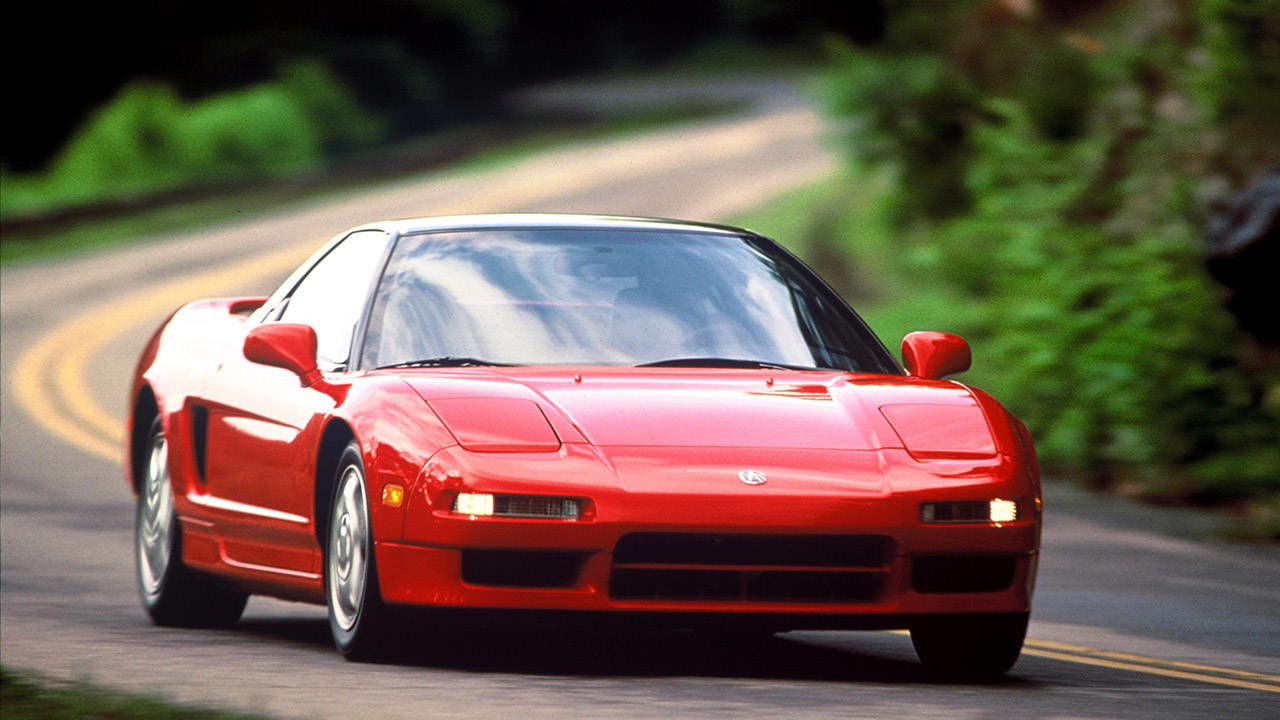
When the Acura NSX made its debut back in 1990, people were skeptical that a manufacturer like Honda could build a super car. "What is a Japanese company that builds people movers for a living doing trying to building a mid-engined super car?" But rather than some tepid, boring, wannabe sports car, the NSX stunned the automotive world. This was a car that performed as well as, or some times better than, super cars from Europe. In fact, the NSX's performance was so stunning, that it actually made manufacturers like Ferrari and Lamborghini worry. "These guys from Japan built a car that rivals the performance of our cars, costs half the price, and starts every time!" If you own a modern European super car, you can thank Honda for the fact that your car will start most of the time.
2015 turned out to be a much busier year for the two of us than either of us had expected. Our day jobs ended up consuming quite a bit of time, which meant there was not quite as much time to focus on test drives and the wheeled world in general. That does not mean that there were not moments in 2015 that really stood out for us when it comes to our favorite wheeled transportation methods. Here are a few moments that we truly enjoyed from 2015, some of our most popular posts, as well as a look at what to expect in 2016.
It seems almost cliche to write a wish list for this time of year, but given that this is the first Christmas I am spending in my newly adopted home town of Long Beach, I thought it appropriate to share a few things that I would like to see happen in coming months. Most of this is borne of experiences since moving here in February, much of it slightly harrowing to say the least. I certainly do not expect any of this to change on its own and am working to participate in the civic process to try to help improve things, but it takes more than one person, even one organization, to really effect the kinds of change necessary to make things better.
I suspect most people are familiar with Craigslist, the web bulletin board where one can get everything from a new job to a blow job. It is the digital swap meet where people can buy and trade just about anything for mostly free. I am a long-time user of Craigslist and frequently peruse the cars for sale and have used it to buy and sell a number of different things over the years. Anytime we move to a new city, Craigslist is always our first stop for apartment hunting. In many ways, some of my most treasured possessions have been discovered on Craigslist. Both of my current bicycles were acquired through hunting around on Craigslist. The Shogun is one of my best purchases ever and the nearly brand new condition Orbea Orca a close second. Both of my wife's bikes were Craiglist purchases also and we have been extremely happy with those as well. But when it comes to selling things on Craigslist, the experience is certainly not anywhere as pleasant.
Once a company establishes an image with consumers, it tends to stick. Car manufacturers all have different images associated with them. For example, Toyota has been known for building reasonably priced, reliable, but boring vehicles. Volvo is known as a lead innovator in automotive safety technologies. Subaru is often regarded as the manufacturer for enthusiasts. However, not all manufacturers have had the good fortune of having a positive image attached to their name. How difficult is it for a manufacturer to shed their image?
Image courtesy of Logopedia
This question comes to mind because of a certain vehicle I encountered on the way to work one morning. That vehicle was the Cadillac CTS V-Sport, which is one step down from the full on CTS-V. Even though it is not powered by a rip-roaring supercharged V8, it is certainly no slouch. With a twin turbo V6 under its hood pumping 420 horsepower to its rear wheels, it is definitely not slow. This particular CTS V-Sport had a certain flair though. On its hindquarters was a D3 badge. For those unfamiliar with the name, D3 is a noted Cadillac tuner, known specifically for working on Cadillac's "V" line of cars. If the badge was any indication, it meant that this CTS V-Sport must have had some work done to it. As I pulled up next to it, I expected to maybe find a man in their 30s, possibly 40s, face adorned with aviator sunglasses. Instead, I found a man who was at least in his 60s, hunched over the steering wheel, looking like he was struggling to drive the car. The first thought that came to my mind was, "is all that effort Cadillac is putting into re-branding itself not working?"
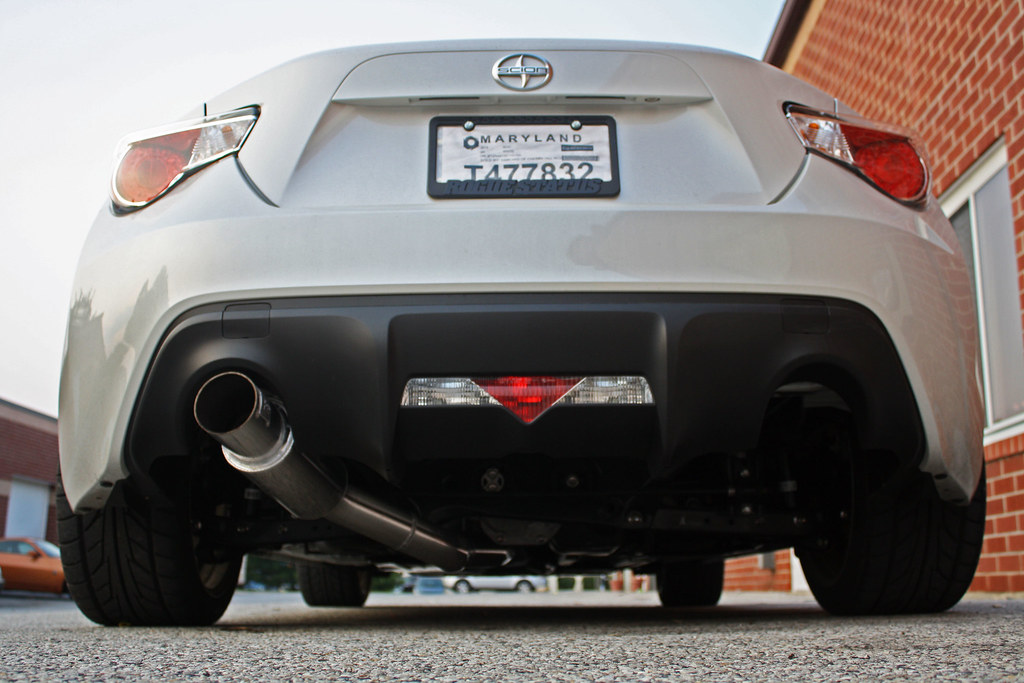
Let me start by saying it is not that I do not understand why people do them. There are certain cars out there that come from the factory with a dual outlet exhaust system, but does not really benefit from it aside from looks. There is also the fact that most single outlet exhaust systems will weigh much less than dual outlet systems. What I do not understand is why people do the dual to single conversion, and then just leave the unused exhaust cutout on the bumper.
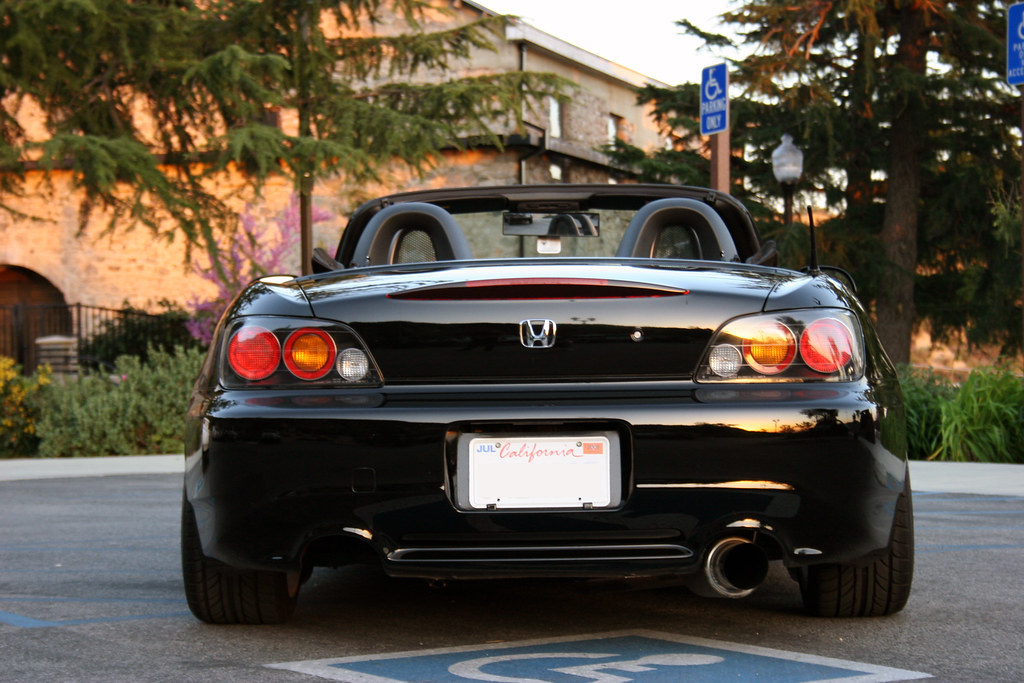
Take my S2000 for example. There are a ton of single outlet aftermarket exhaust systems for the S2000. Even though it looks much better, the S2000 really does not benefit from having a dual outlet exhaust system. Taking a closer look at the S2000's full exhaust system, you will notice that the exhaust headers feed into a single pipe. Besides the fact that most inline engines would never benefit from the exhaust header feeding into more than one pipe, the car was not designed for more than one pipe anyway. In this sense, doing the dual to single conversion makes sense. It also helps that many of the single outlet systems designed for the S2000 are much lighter than their dual outlet counterparts. However, look at the above picture and take a good look at the bumper. How unsightly is it to see a giant, unused gap in the bumper? It just does not look right. If the average Joe saw that, they would wonder why you removed a chunk of your exhaust system and left a big gap in the bumper for no reason. Another car this happens to a lot is the Scion FR-S/Subaru BRZ. Look at the first picture of that white FR-S. Again with the unsightly and unused exhaust cutout. The bumpers were designed like that because they were designed for dual outlet exhaust systems, folks!
Thankfully, there are companies that make aftermarket bumpers that have the unused exhaust cutout removed. Ultimately, this makes the car look much cleaner without the big gaping hole in the bumper. Just take a look at this black S2000. It almost looks as if it came out of the factory looking like that! There are also companies that just make caps that go over the unused cutout. Frankly, slapping a cap over the unused cutout looks really tacky. It is the same with car manufacturers that are too lazy to make two separate bumpers for cars that are available with both single and dual exhaust outlets, and just slap a cap over the unused outlet on their single outlet cars. If you are going to go the single exhaust outlet route, at least do it right and clean up the look so that it looks clean and sleek, not tacked on and cheap.
Ultimately though, I believe that cars that come from the factory with a dual exhaust look best with a dual exhaust system. Whether you stick with the factory exhaust or want to enhance the sound and power output of your car with an aftermarket system, if it comes with a dual exhaust, I think you should stick with it. Yes, it may weigh more and yes, the car may not actually benefit from maintaining a dual outlet setup, but ultimately the weigh difference is usually not much and it just looks better. Besides, when the vehicle was originally designed, the designer probably designed it with a dual exhaust because in the first place. Why go undo what the designer spent months, or even years to create?
I had planned on running an editorial on a different topic, but reading some of the commentary on several recent incidents involving cars and two-wheeled vehicles along with nearly getting run over by cars while crossing the street last week has me more than a little upset at the callous attitude so many drivers exhibit. The most recent incident, shown in the video below, records one of the most unnervingly unsympathetic and completely sociopathic people I have ever seen. Shortly after swerving to cause a motorcycle carrying a passenger to crash, this driver has the gall to stand there and declare, "I don't care" when he is questioned about what he just did. Such disregard for human life is not just a little scary, it is downright run-for-the-hills alarming. Then, to make matters worse, the comments from other people start to pile on and, protected by the anonymity of the Internet, we get to really see what people think of those of us who choose not to get around everywhere surrounded by the metal crash structure of a car.
My own experience this past week has not been significantly better. On one occasion, while crossing at a signal controlled intersection, within the boundaries of the clearly marked crosswalk with a clearly visible walk signal, my dog and I were nearly run down by a livery driver who thought it was entirely appropriate to enter the crosswalk as soon as I had cleared the space he wanted to occupy, barely missing us by inches. Naturally, such a close encounter is going to startle a pedestrian and I immediately spun around to confront the driver of the large black SUV, who threw his hands in the air in exasperation as if he were confounded by why I was upset. Setting aside the fact that he was in clear violation of the law, which requires that drivers refrain from entering a crosswalk until pedestrians have cleared it completely, his lack of any semblance of guilt for the maneuver, compounded by his clear lack of giving a shit for my safety, sent me into a rage, causing an expletive laden diatribe to pour forth from my mouth. The SUV screeched off and I was left upon the side of the road seething in an adrenaline fueled state of anger.
Stories like this are all too common among the cycling community as well. There are countless stories of drivers intentionally making efforts to intimidate riders who are following their legal right to use entire traffic lanes. Some drivers go so far as to knock the rider over, force them off the road, or otherwise cause them bodily harm. When such incidents are reported in the media, the commentary that follows usually devolves into a cesspool of shameless victim blaming with many people voicing the sentiment that the cyclists "got what they deserved" for taking up the whole lane.
I believe this mentality towards anyone not ensconced in the confines of a car seems stem from a few key areas: ignorance, unfairness, and lack of education.
The ignorance comes in many flavors. It could be ignorance of the laws. It could be ignorance of the experience of others. It could just be plain and simple ignorance because of lack of exposure. Whatever, the cause, ignorance can be a tremendously dangerous fuel for dangerous and destructive behaviors. One of the greatest areas of ignorance for many Americans is simply an ignorance of perspective through the eyes of another road user. Most Americans will never ride a motorcycle during their lifetime and most stopped riding bicycles when they became old enough to drive. Since our culture is so dominated by driving, most Americans hardly spend time as pedestrians anymore, aside from the walk from the car door across the parking lot to enter the fast food join where their dinner awaits. Not understanding how the world view is different through the eyes of a pedestrian, cyclist, or motorcyclist leads to a lack of understanding of what is perceived as dangerous. Driving in a car, passing a pedestrian or cyclist with less than a foot of space may seem totally safe to a driver, but is a shockingly close call to someone without any kind of physical protection.
One of the most common arguments against the idea of letting motorcyclists lane split is that it is "unfair" for drivers to have to sit in traffic while motorcyclists get to zoom ahead. A common myth levied against cyclists using traffic lanes is how "unfair" it is that cyclists are allowed on the roads but do not have to pay registration and taxes to help pay for those roads. Both of these try to appeal to a sense of "fairness" that taps into the absurdly selfish belief that road use is somehow a zero sum game. If someone else is getting some kind of advantage, then it must be taking away from you in some way. We have turned road use into a kind of sick reality TV competition where the winner gets a crap prize accompanied by their 15 minutes of Internet fame. This attitude is also what leads to some of the more epic road rage incidents as one entitled person takes out their frustration on another in some misguided belief that this will somehow result in them being happier, but only ends up with them in jail.
As for the lack of education, it is a topic that I often revisit. Our driver education system is so pathetic as to be laughable. Not only do we fail to instill in drivers the rules of how to safely operate two ton weapons on the road, we fail to do any semblance of follow-up to make sure that they remain safe in their operation. Just as we license doctors and require them to re-qualify for their license every few years, drivers should be required to update their qualifications from time to time to ensure that they understand how rules have changed or evolved. On top of that, our driver education testing is atrociously inconsistent and lacking in interactions with other road users that it should be no surprise that most drivers simply have no idea what the laws are that pertain to motorcyclists, cyclists, or pedestrians. Testing criteria should be standardized and much more comprehensive and the standards much more stringent to ensure that the pilot of a two-ton box of metal is fully able to comprehend how serious the task of driving really is. Triggers for automatic failure should include reaching for a phone, hitting anything of any kind, and any moving violation that would normally result in a traffic citation. Of course, these standards are going to be the most difficult to change as legislation to alter driving requirements is often met with opposition that rivals the wrath of Zeus himself. There are certainly many advanced driver education options throughout the country and bless the hearts of those who invest the time and money to take those for their own, and everyone's, sake.
At the end of the day, regardless of how utterly ridiculous the current situation might be, what really needs to happen is that everyone needs to learn a bit of respect for everyone else. Just because someone has made the decision to not drive a car does not make them any less of a person. Do not judge them for their choice and instead, focus on your own.
Choose to be respectful of the rights of all road users.
Choose to educate yourself about the rules of the road and follow them as best as you can.
Choose to leave a little earlier so that you are not in a rush and cause chaos along the way.
Choose to allow a greater margin for error anytime you are behind the wheel.
Most importantly, choose to be aware of your surroundings and realize that your actions have an impact on your environment and take responsibility when you make a mistake. There is no faster way to diffuse a situation than to be genuinely apologetic, own your mistake, and communicate that to the other party.
As for the driver above, who exhibits such an abhorrent disregard for human life, I hope that he is punished to the fullest extent of the law for his actions. At a very minimum, I hope such a driver has his driving privileges revoked for the remainder of his life.
In a recent study done by JD Powers, some 20 percent of new car owners do not know how to use half of the technology that they have paid for even three months after purchase. That three month period is considered the sweet spot for adoption of new technologies when an owner purchases a new vehicle so the fact that there is a rather sizable number of people who spend the money but do not actually use the technology should give manufacturers and consumers pause. I see this being a problem from a few different perspectives.
For consumers, this means that new technologies are probably being bundled together in a way that more desirable and adoptable technologies such as navigation systems or blind spot detection are combined with systems that people are not using such as in-vehicle concierge services and WiFi hotspots. As much as I dislike the idea of having a car where every single item is a separate option and it is next to impossible to find your exact combination on a dealer's lot, I also feel that consumers are getting cheated here because the bundling of unwanted technology with more desirable technology is a way to drive up the final selling price of the car. It also means saddling a car with more things that impact fuel economy, packaging, and reliability in the long run.
For manufacturers, the fact that these new technologies represent possibly millions in resources, contracts, or research costs means that must be recouped somehow. That means raising the cost of vehicles to compensate, but also adds to the challenges of bringing a vehicle to market that meets the fuel economy, safety, and reliability expectations of buyers without giving consumers sticker shock. In a lot of ways, if funds spent on developing these less desirable technologies were funneled into improvements in other areas, such as increasing fuel economy to meet future CAFE standards or improving integration with widely available and adopted smartphone technologies, that would be a wiser investment on the part of manufacturers.
For dealers, these less desirable technologies represent a conundrum. Because of how they are bundled, salespeople are often saddled with the unenviable position of explaining to a potential customer why the technology is worth paying extra for. That means they need to work harder for every sale and makes the relationship with the consumer that much more contentious if the consumer does not want or care for the additional technology. Some of the new technologies, however, are great marketing tools and represent a whiz-bang factor that can help sell cars to less informed buyers, but for those in the know, it is just another hurdle in the process.
Image courtesy of Android.com
The real problem is that many of these less desirable features are ones that seldom get used aside from serving as a good parlor trick to show friends how cool your new car is. Rather than wasting everybody's time on these types of things, it makes the most sense for dealers to make it clear to manufacturers what people actually want, for manufacturers to stop investing money in areas that are largely unused by consumers, and for consumers to start demanding that these unused technologies start to be replaced by genuinely useful innovations.
On my own Ford Focus Electric, I would happily have traded in the Ford Sync system for Android Auto. It would have saved Ford millions in R&D and public derision and I would be a lot happier.




 Oh where do I begin...

 I recently attended a meeting of my region's Council of Governments (COG), which is a body made up of the leaders of the region's cities and helps to set priorities and plans for programs in areas ranging from community development to pollution control to transportation planning. It is this last area that was of interest to me as I was there to speak on behalf of an advocacy group that was seeking discreet funding for active transportation projects. Listening to a few presentations on the already established priorities and the current state of various projects followed by debate on the recommendation to offer discreet funding for active transportation projects, it became immensely clear that this body is one of the key reasons why our roads in much of the area are often terribly congested.


.png/revision/latest?cb=20140116173257)