Showing posts with label bike lanes. Show all posts

Friday, October 16, 2015

News: Salt Lake City has launched the first protected intersection in the US

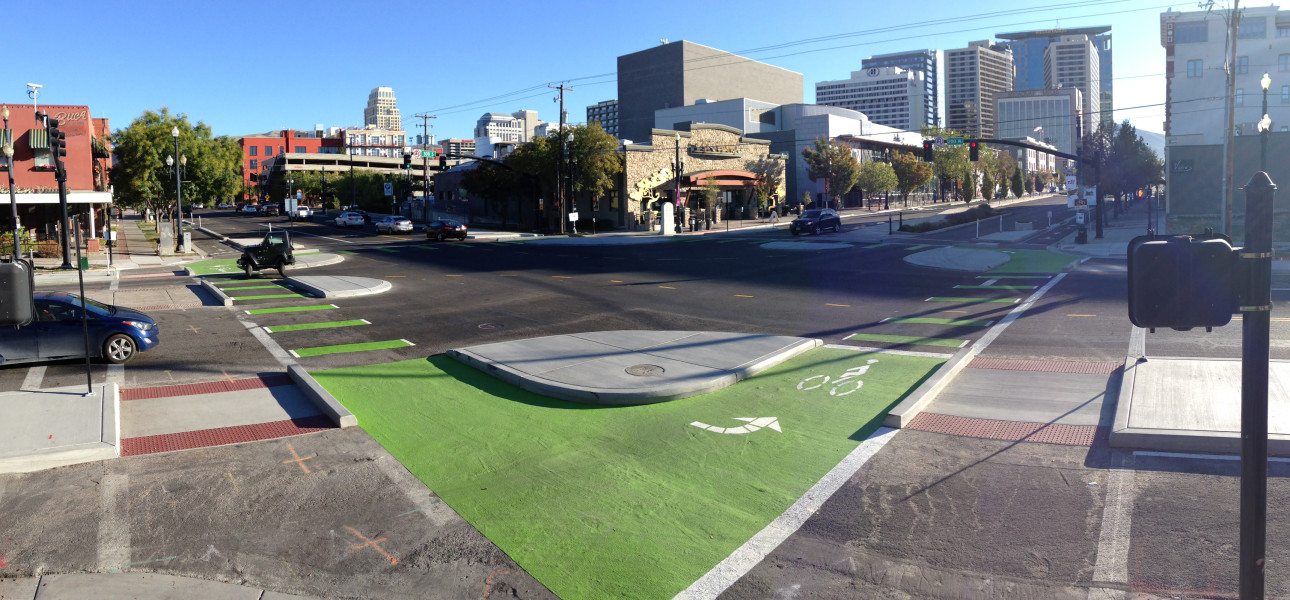
The development of cycling infrastructure is a constant struggle to balance the needs of cyclists, pedestrians, and motorists. Many municipalities continue to turn to third party design firms for new ideas on how to strike the appropriate balance, and one such firm has adapted a concept that is increasingly popular in Europe and put in place a working example in downtown Salt Lake City. Alta Design + Planning, which specializes in active transit planning drew inspiration from similar intersections in the Netherlands and worked with SLC city planners to get it implemented at a heavily trafficked intersection of two cycle tracks.

Image courtesy of Alta Planning + Design
By adding some small concrete islands in strategic locations, the new protected intersection provides clearly demarcated paths for cars, bikes, and pedestrians, extending the separation and protection offered by the cycle tracks. Additionally, by using the concrete traffic islands, a space is created to shelter bikes that need to make a left turn, making it so that cyclists no longer need to maneuver across several car lanes in order to get over to the left turn lane. This makes the entire process of a left turn much less disruptive to the overall flow of traffic and helps to reduce the potential of crashes resulting from right of way violations. As an avid cyclist, I would welcome this kind of intersection anywhere there are protected cycle tracks. The good news is that several other cities are evaluating similar intersections or in various stages of implementation.


Wednesday, October 8, 2014

News: Bike lanes do not slow down car traffic

Many drivers have the misconception that anything that removes space from their precious roads is an impediment to their forward progress. The loss of lanes to parking is already an affront to their vision of free-slowing traffic, so one can only imagine that the loss of a traffic lane, or even the reduction in the size of a traffic lane, in order to install a bike lane would be a truly serious offense in their eyes. The idea that slow moving traffic would somehow have no impact on the free flow of traffic seems antithetical to traditional logic.

And yet, a recent study of bike lanes in New York City, one of the most traffic snarled metropolises in the US shows precisely that. The installation of bike lanes, particularly those protected bike lanes that completely separate car traffic from bike traffic, have not only not slowed down traffic, but in some cases, have actually improved traffic flow. On top of that, not only has traffic improved, but cyclist injuries, pedestrian injuries, and traffic incidents have decreased in significant numbers.

If in a massively traffic snarled city such as NYC, protected bike lanes are able to have such a tremendous impact, imagine what adding these to other major cities, such as Los Angeles, could do to improve driving conditions and reduce congestion. NYC has the obvious advantage of greater population density, but even adding them to the immediate suburbs surrounding the city of Los Angeles would make a tremendous difference in the near term and combined with greater investment in public transit options, could make dramatic improvements in the long term. Hopefully more studies will continue to reveal that increasing bike traffic in major cities is a great way to ease car congestion and, perhaps, reduce pollution as time goes on.

Link to the full study after the jump.


Monday, July 7, 2014

Editorial: Exploring a new city by bike is just awesome

I really did not realize it until this weekend, but many of my best childhood memories of family trips ultimately involved cycling and bodies of water. Whether it was riding along the perimeter of Lake Tahoe as a family on rented bikes or along the sandy beaches of Santa Barbara in a pedal-powered Double Surrey, some form of human power along the wet stuff manages to ingrain itself deeply into my memory. Most recently, I spent a weekend with my wife and some friends, exploring the Canadian city of Montreal by Bixi, their local bike share system.

A city like Montreal, which is extremely cycling friendly (with over 300 miles of bike paths, including numerous dedicated cycle tracks and designated bike lanes, as well as about 5,000 bike share bikes available), is the perfect place to explore on two-wheels. Due to the proliferation of bike lanes, it was possible to crisscross the city fairly quickly and see a huge variety of sites in the limited amount of time we had. When we got to a place we wanted to explore in greater depth, there were bike share stations for us to park the bikes in and continue by foot. Even on the heavy Bixi bikes, the relatively limited elevation changes were manageable and the mild weather helped make the experience an extraordinarily pleasant one. And at CAD $15 for 72-hours and the ability to get anywhere in the city without worrying about parking, it was an inexpensive (if not quite totally hassle-free) option.

From the weekend in Montreal, I feel like there were two important takeaways for me:

1. Cities that want to improve tourism should invest increasingly more in cycling infrastructure and a bike share program.

2. Cycling is an excellent alternative to other public transit options, such as taxis or even light rail because if offers greater flexibility.

As a tourist, having the option and flexibility to get around a new town on two-wheels encourages me to explore a city more and allows me to spend more time checking out local merchants and restaurants. Plus, given how inexpensive it is as an option, it allows me to have a little more money to spend while I am in town. And the ability to come and go as I please and not be constrained by schedules or bumper-to-bumper traffic is a highly liberating sensation. With a big cross-country, multi-city trip coming up soon, I am looking forward to seeing many Mid-west cities by bike, albeit on my own bike this time.

Monday, March 31, 2014

Editorial: Build more public transit and all road users will be happier

Image courtesy of Inhabitat.com
For most Americans, when we think of transportation, we start by thinking about cars first. That is how most of us have grown up and most Gen Y and Millennials have spent countless hours in their family's cars, traveling to and from school or extracurricular activities. Oftentimes what we grow up with has a major impact on how we perceive situations as adults. With transportation, it is no exception as most Americans still get up in the morning and drive to work every day. Yet, things are beginning to change.

In 2013, American public transit use reached its highest level in 57 years. The report, compiled by the America Public Transportation Association (APTA), noted that the 10.7 billion (yes, that's billion with a "B") trips are composed of largely mass transit options, such as buses and trains, which have made a comeback as uncertain economic times have discouraged many American's from spending the funds on a personal vehicle. Combine that with the increase in cycling in urban environs, and Americans seem to be making a conscious shift away from personal vehicles.

Monday, February 24, 2014

News: Suffolk County, NY legislator wants no bicyclists or motorcyclists on his roads

Here is a new twist in the 2-wheel vs 4-wheel debate.

Matthew Cutrone, a young concerned citizen wrote to his legislator about the recent accident that involved his mother, who was riding a bicycle, being hit by a work van whose driver claims he did not see her (an all too common excuse, unfortunately). In the letter, young Matthew asks for the addition of a bike lane or signs in the area to raise driver awareness of the presence of bicyclists. The request seems like a perfectly legitimate one and would hardly have been difficult to implement plus would have likely had widespread support given that Suffolk County, which comprises the majority of Long Island, is popular with cyclists for its many miles of coastal roads.

The response from one Thomas Barraga, however, could not have been any more absurd. Instead of replying in a diplomatic manner, he chooses to talk about how he actively tells people not to take up bicycling and that "drivers expect to see other drivers on the road not bicyclists and motorcyclists." He goes on to talk about how signs and bike lanes are worthless because they do not have much effect since drivers ignore them. It seems that Mr. Barraga has it in his head that nobody but drivers have rights in Suffolk County and that, just because he personally seems to dislike them, everyone else should stay off his roads. Perhaps while we are at it, we should remove crosswalks and sidewalks too since drivers would not expect to pedestrians either.

I have never heard such an utterly outrageous response and, as a bicyclist and motorcyclist, will be all too happy to stay away from Suffolk County and never bring my hard earned dollars to that part of New York. However, if this is how local legislators think about the 2-wheel vs 4-wheel issue, then it is no wonder we cannot make any progress and have civil discussions about real solutions. I hope that most people are smarter than West Islip's village idiot and can see the absurdity of his narrow world view.

Here is his letter, word for word:

Sunday, September 22, 2013

Editorial: Dispeling myths about cyclists

In recent months, I have been doing a lot of reading and watching a lot of videos about interactions between cyclists and motorists all over the world. In many instances, there is a lot of loud screaming and foul language, although mostly it comes from the commenters. Worst of all, the screaming and yelling is frequently the result of misunderstanding and myths about the rules of the road and of cyclists. In a, perhaps misguided, attempt to dispel some of the myths, I have chosen three of the most popular myths to try to set the record straight.