A frequent argument that many cycling detractors use against cyclists is that they do not pay taxes and therefore do not have a right to use the road. While the usual counter argument to this fallacy is that many cyclists are also owners of cars, and thus pay their share that way, there may be a different argument that could have an even greater impact. What if I told you that getting more people to ride bikes could actually have an improvement on the overall US economy?
At first glance, that seems almost too simple so as to be laughable, but hear me out. The Wall Street Journal recently published an article discussing how the
US economy was being impacted by the inability to maintain and replace aging infrastructure that forced many US companies to lose efficiency in the name of meeting their obligations to customers. One example they gave was that the amount of congestion in large cities can get so bad that UPS, one of the largest package delivery operations in the world, was forced to place additional trucks on the road to cover the same route just to be able to ensure that they could make all of their deliveries on time. Having those extra trucks on the road not only adds to the congestion that is causing the problem, but also contributes towards pollution, a less visible cost. Those extra trucks also result in greater wear and tear on that aging infrastructure, further accelerating its deterioration.
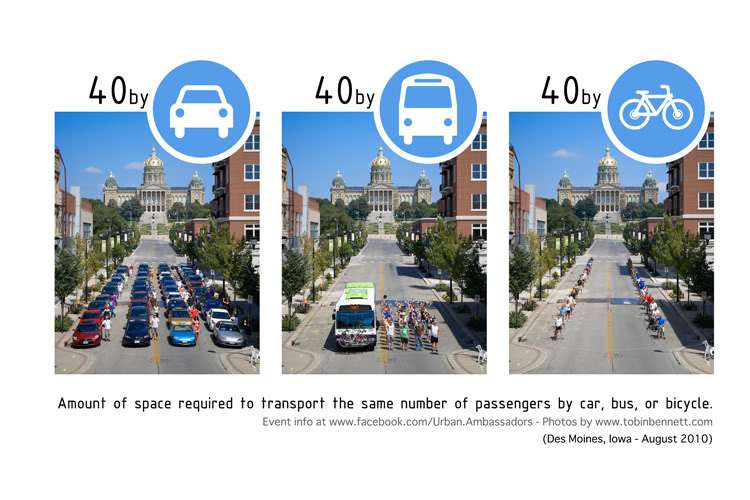
Take a city like Los Angeles, which is notorious for its traffic congestion and constant road work to maintain a massive network of roads that allow people to make their daily commutes. According to the US Census Bureau's 2009 American Community Survey, there are around 5.5 million commuters in the LA-Long Beach-Santa Ana metro area that commute to work every day and 84% of those commutes are taken by car. Of those commuters, 21.15% of them drive less than 15 minutes in order to get to work. That means there are potentially 1.17 million people who could probably ride a bicycle to work. If we conservatively estimate that we could switch 1 million people from driving to bicycling or other forms of mass transit for their commutes, that would remove close to 1 million cars from the roads during the most congested times, a reduction of nearly 20% in the volume of cars on the road.
 |
| Image courtesy of irishcycles.com |
If we think about this further, that reduction in congestion would make commerce more efficient and would reduce the amount of money, time, and energy we would need to spend on maintaining and upgrading roads and other infrastructure. At the same time, to accommodate the increased volume in cyclists, new projects could be planned that provide protected cycling infrastructure to help urban and suburban roads handle the extra bike traffic which would be long lasting as bicycles, with their significantly smaller footprint, do not place much wear and tear on roads. Additionally, all of those cars off the road means less gasoline consumed and fewer pollutants released into the air.
 |
An example of the kind of bike infrastructure
that could be built |
Now the economic impact comes in a few different ways. One, the consumer spending on cycling and related equipment would provide a boost to the retail segment with many local bike shops as well as big box retailers receiving the bulk of the benefit and hopefully needing to hire more staff to handle the increase in sales. Two, studies show that cyclists are more likely to spend funds locally, which means local economies will likely see a boost in sales from the increased presence of cyclists leading to more sales tax revenue. Three, cyclists tend to be healthier so spending on healthcare will decrease allowing for more disposable income to be spent elsewhere, providing a boost to the retail and restaurant sectors. Four, the projects needed to put in place proper infrastructure to handle the larger volume of cyclists will also create new construction jobs locally that, while temporary, will help put more people to work. A side benefit of this is that cycling is more accessible to people and by improving the infrastructure, it allows more people to go further to seek out job opportunities. Finally, the reduced congestion and fewer cars on the road allows for an opportunity to finally fix all that aging infrastructure and design it properly to accommodate the new traffic demands, leading to yet more construction jobs.
Of course, this is a greatly simplified look at the potential economic impact of increasing cycling, but hopefully one that provides some food for thought. While it is not possible for everyone to do, anyone who drives less than 15 minutes to get to work should take a serious look at cycling as a viable alternative for their commute. By making a minor change, especially in an area where the weather is cooperative year-round like Los Angeles, could have a tremendous impact on the overall quality of life all the residents in the area.

 As much as I love my S2000, I have to admit that it is starting to wear me down a bit physically. I recently changed jobs, necessitating having to travel to West Los Angeles daily. This is only a mere nine miles north of where I used to work by LAX, however, during rush hour traffic, that nine miles easily translates to an extra 30 to 40 minutes added to my commute. Driving from the South Bay to LAX and back was not all that painful, but driving from the South Bay to West LA and back is starting to actually hurt my back. It is also probably not good for my blood pressure either, as I find myself angry at other commuters far more often than I used to be.


.svg/480px-I-110_(CA).svg.png)

.svg)